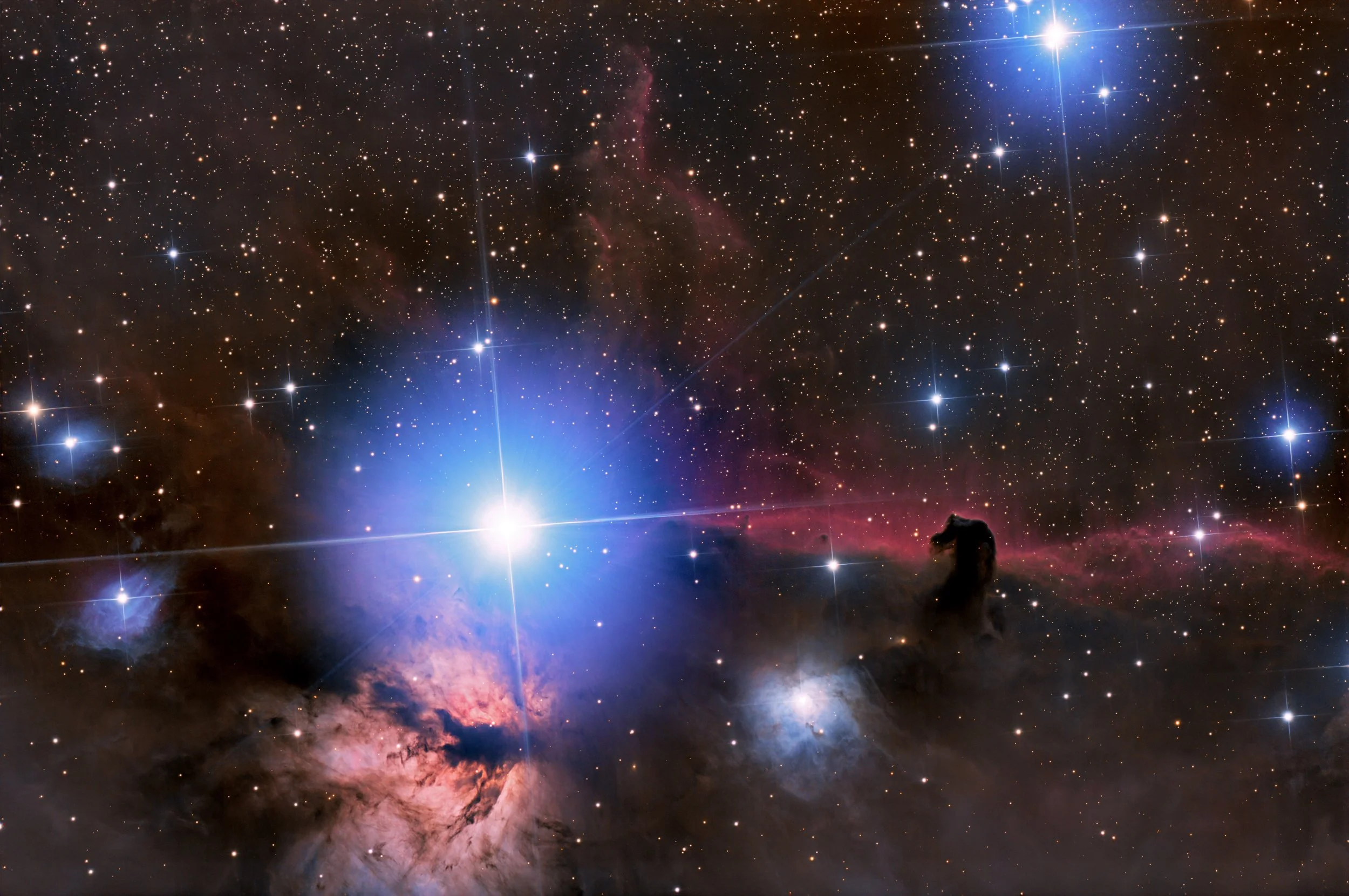
The Horse Head Nebula region
About Image:
The Horsehead Nebula (Barnard 33) is a famous dark nebula in the constellation Orion. Located about 1,375 light-years from Earth, it appears as a swirling cloud of dense cosmic dust and gas silhouetted against a glowing pink emission nebula (IC 434), visually resembling a horse's head.
Why It's FamousThe Horsehead Nebula is one of the most identifiable and frequently photographed objects in the night sky. It owes its distinct shape to a tall column of thick, cold gas and interstellar dust that obscures the visible light from objects behind it. The iconic red background glow comes from the ionized hydrogen gas (IC 434) that is being illuminated by a nearby massive, hot star, Sigma Orionis.Star Formation and FutureWhile it appears dark and quiet, the Horsehead Nebula is an active stellar nursery. Deep infrared observations have revealed embryonic "low-mass" stars developing within its dense cloud base. However, the intense ultraviolet radiation from nearby hot stars is slowly eroding and sculpting the nebula. Astronomers estimate the Horsehead will disintegrate entirely in roughly 5 million years.Observing the NebulaFor amateur astronomers, spotting the Horsehead Nebula visually is notoriously challenging. Because it is a dark nebula rather than an emission nebula, it requires a very dark sky, a medium-to-large telescope (usually 5 to 8 inches or larger), and a specialized hydrogen-beta filter to glimpse clearly.
Equipment & Details:
Optics: Orion 8” inch 3.9f Newtonian astrograph with 2" MPCC Mark III coma corrector
Camera: Canon 60D DSLR unmoddified
Mount: Celestron AVX
Guiding: Orion: starshoot autoguider 60mm guide scope
Dates: November 12, 13, 16, 17-2023
Location: Clarksdale Missouri
Exposures: Lights 200 x 4-minutes subs, ISO-1250 total 13 hours 20 minutes
Processing: Pixlnsight, Photoshop CS5